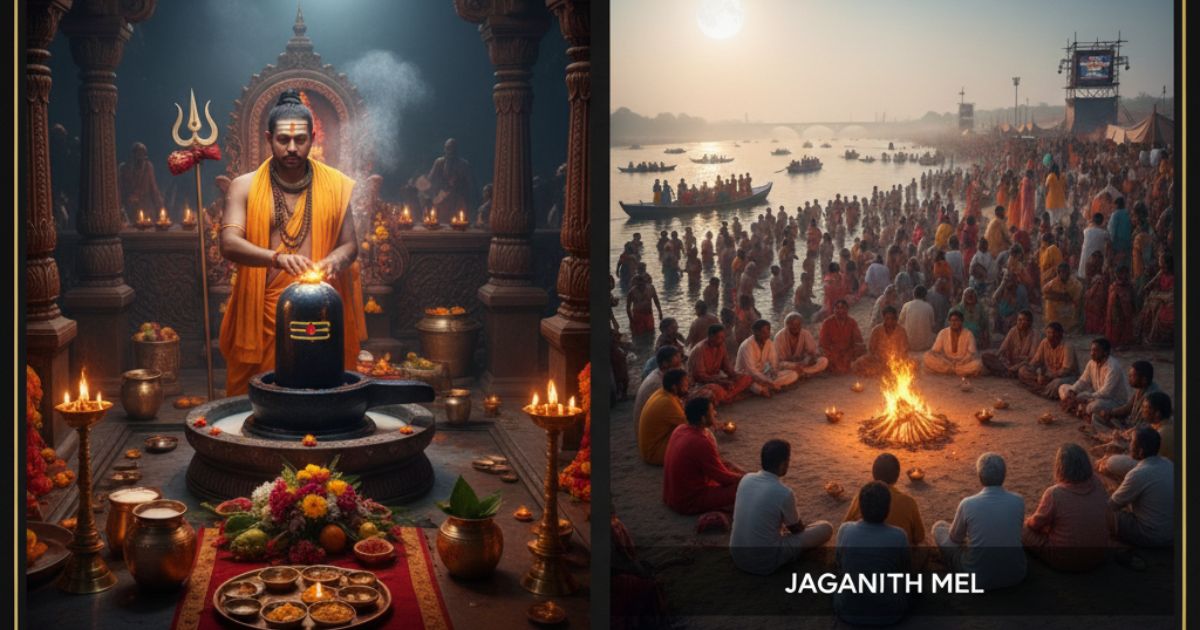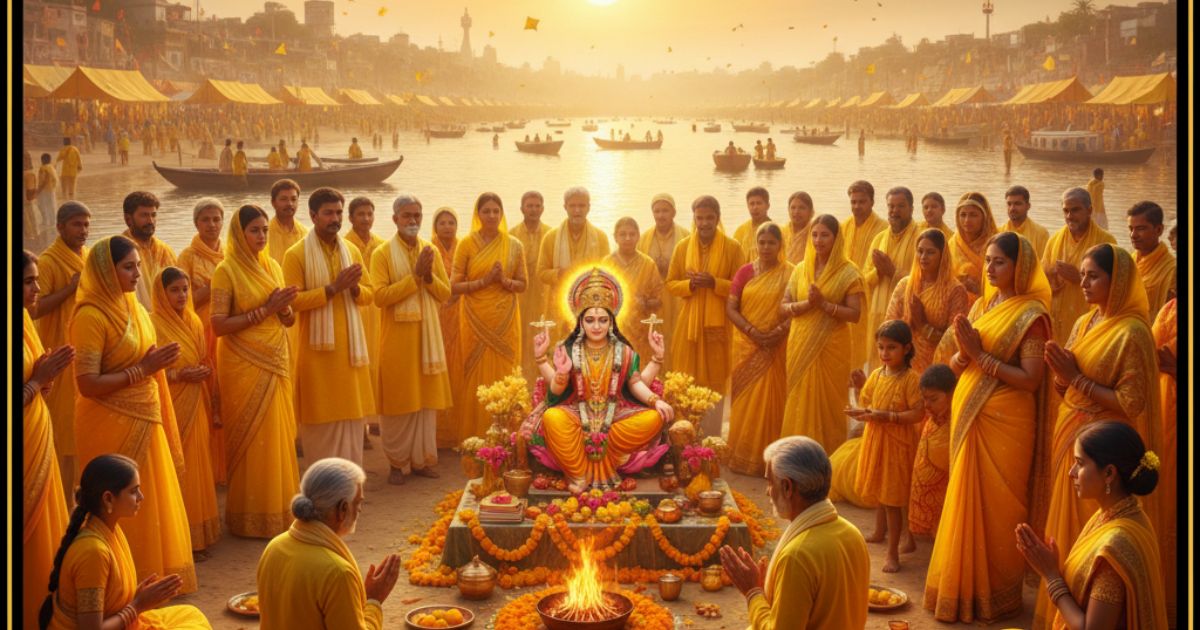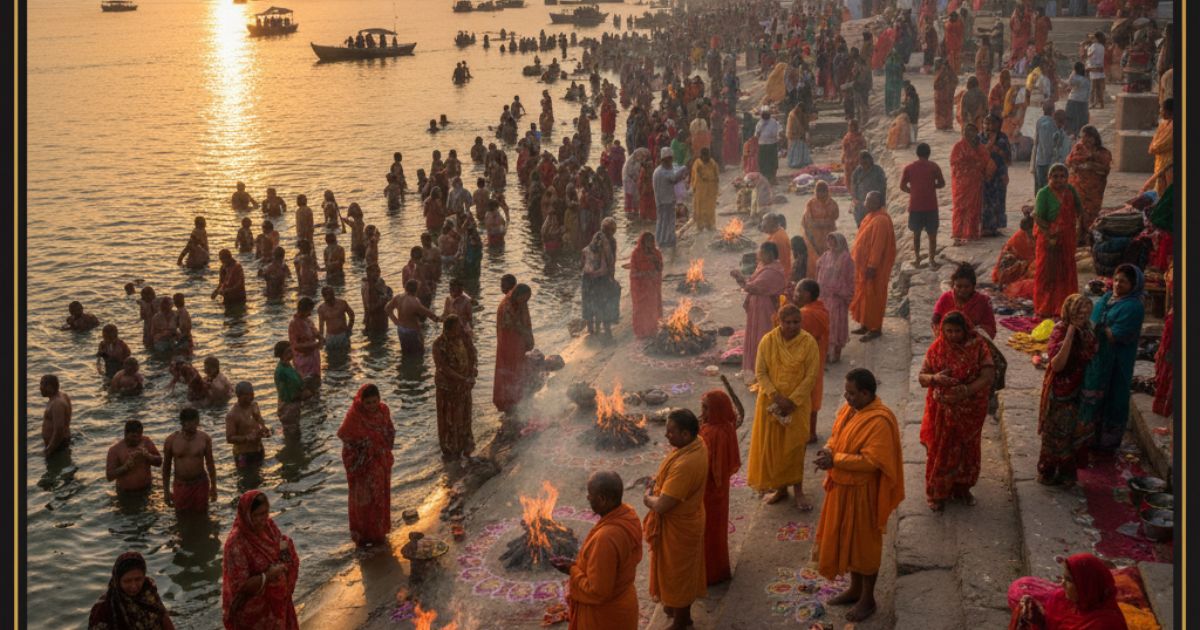
Learn why Prayagraj Sangam is considered sacred, highlighting its divine confluence of rivers, mythological importance, purification rituals, and centuries-old spiritual faith.
Stand at the edge of the world’s most sacred confluence, where three mighty rivers merge, and you’ll feel something inexplicable—a presence that transcends the physical, an energy that predates recorded history. This is Prayagraj Sangam, the Triveni—literally “triple braid”—where the visible Ganga and Yamuna embrace the invisible but eternally flowing Saraswati. But what transforms this geographical point into the spiritual epicenter of Hindu consciousness?
Is it merely religious sentiment that draws millions to this spot annually? Or does something deeper—something ancient, powerful, and transformative—actually exist here? The prayagraj sangam significance isn’t just a matter of faith; it’s woven into the very fabric of Indian spirituality, philosophy, and cultural identity spanning millennia.
From the Vedas that first proclaimed its glory to modern seekers who experience inexplicable peace at its banks, from ancient rishis who chose it for their highest spiritual practices to contemporary scientists intrigued by its unique properties—the sacred rivers confluence at Prayagraj commands attention, reverence, and wonder.
This isn’t just another pilgrimage site. This is where heaven and earth are believed to meet, where the mortal sheds the burden of karma, and where the impossible—liberation itself—becomes possible. Let’s explore why this confluence has held humanity’s spiritual imagination captive for over three thousand years.
Understanding Triveni Sangam Meaning: The Triple Confluence
The Three Sacred Rivers
The triveni sangam meaning lies in the union of three sacred rivers, each carrying profound spiritual symbolism:
Ganga (Ganges): The holiest river in Hinduism, Ganga is personified as the goddess Ganga. According to mythology, she descended from heaven to earth through Lord Shiva’s matted locks to purify the souls of King Bhagiratha’s ancestors. The Ganga represents:
- Purity and Purification: Her waters are believed to cleanse all sins
- Moksha (Liberation): Death near Ganga or with Ganga water ensures release from rebirth cycle
- Divine Grace: She embodies compassion and mercy
- Spiritual Knowledge: Her flow represents the continuous stream of divine wisdom
Scientifically, the Ganga water contains unique bacteriophages that prevent bacterial growth—a phenomenon that intrigued even the British during colonial times.
Yamuna: The second visible river, Yamuna is associated with Lord Krishna, who spent his childhood on her banks in Vrindavan. She represents:
- Devotion (Bhakti): Her connection to Krishna symbolizes the path of loving devotion
- Karma Yoga: The river of action and duty
- Earthly Life: While Ganga is celestial, Yamuna represents worldly engagement
- Beauty and Aesthetics: Her dark waters contrast beautifully with Ganga’s lighter hue
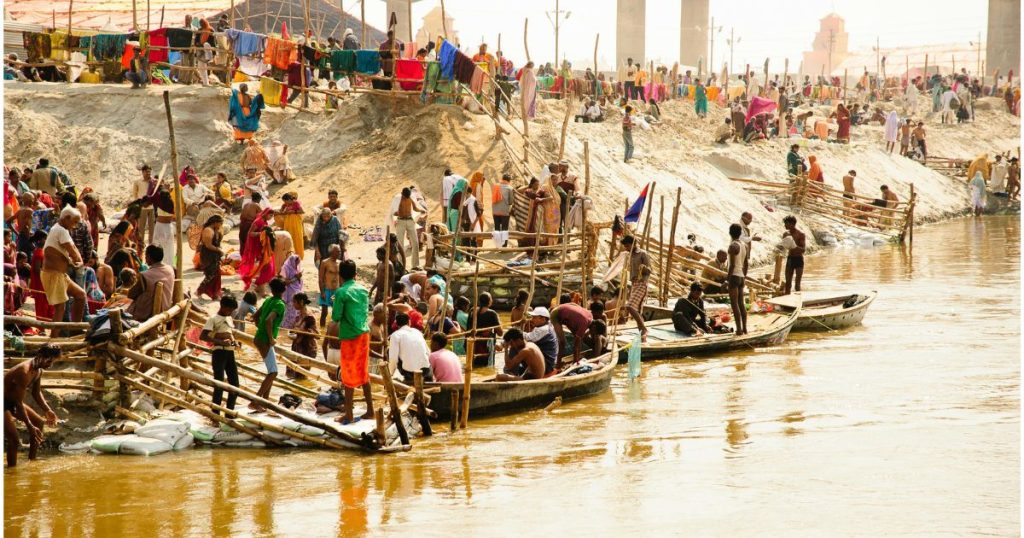
At the Sangam, you can visually distinguish the two rivers—Ganga’s greyish-white waters and Yamuna’s darker blue-green streams flowing side by side before merging.
Saraswati: The invisible third river represents the greatest mystery of the triveni sangam meaning. Once a mighty river according to Vedic texts, Saraswati is now underground or disappeared. She symbolizes:
- Hidden Knowledge: Esoteric wisdom not accessible to all
- Intuition and Inner Vision: What cannot be seen but must be felt
- Spiritual Wisdom: Goddess Saraswati presides over learning and arts
- The Subtle Body: While Ganga and Yamuna are physical, Saraswati represents the spiritual dimension
Archaeological and geological studies have found evidence of an ancient river system in the region, lending credibility to Saraswati’s historical existence. Satellite imagery has traced what might be the dried riverbed of the Saraswati.
The Mystery of Saraswati
Why does the prayagraj sangam significance emphasize an invisible river? Because it teaches a profound spiritual principle: the most powerful realities are often unseen. Just as consciousness, love, and divine presence cannot be photographed yet are absolutely real, Saraswati’s invisible flow reminds seekers that the spiritual realm operates beyond physical perception.
Ancient texts claim that bathing at the Triveni—even if Saraswati is invisible—connects you with all three energies: physical purification (Ganga), devotional activation (Yamuna), and spiritual awakening (Saraswati). The three rivers represent the three paths to enlightenment: Karma (action), Bhakti (devotion), and Jnana (knowledge).
Mythological Origins: Ancient Stories Behind Sacred Rivers Confluence
The Samudra Manthan Legend
One of Hinduism’s most famous myths directly connects to the sacred rivers confluence:
When gods and demons churned the cosmic ocean (Samudra Manthan) to obtain amrita (nectar of immortality), the process yielded both poison and nectar. During the struggle for the amrita pot, drops fell at four locations on earth—Prayagraj, Haridwar, Ujjain, and Nashik—making them the four Kumbh Mela sites.
But Prayagraj received special distinction. According to some versions, Lord Vishnu’s navel is believed to be at the Sangam point. Since Vishnu’s navel birthed Brahma (the creator) on a lotus, this makes Prayagraj the creation point of the universe—the adi tirtha (first pilgrimage site).
The amrita drops at Prayagraj fell precisely at the confluence, charging the waters with immortality-granting properties. This explains why bathing here during Kumbh Mela—when planetary alignments recreate the original cosmic churning conditions—is believed to grant liberation.
Lord Brahma’s First Yajna
Another powerful mythological foundation comes from the Puranas:
Lord Brahma, after creating the universe, sought an ideal location for the first yajna (fire sacrifice) to stabilize creation. He chose the confluence of three rivers as the perfect spot because:
- Water represents the primordial element
- Confluence symbolizes unity in diversity
- The meeting point creates maximum spiritual energy
Brahma performed the Prakrista Yajna (excellent sacrifice) here, establishing Prayag (later Prayagraj) as Tirtharaj—the king of all pilgrimage sites. The name “Prayag” itself comes from “pra” (excellent) and “yag” (sacrifice).
This mythological event explains why performing rituals at the Sangam carries exponentially greater spiritual merit than at other locations. You’re essentially conducting your ceremony at the same spot where creation itself was sanctified.
The Ramayana Connection
The epic Ramayana strengthens the prayagraj sangam significance through several episodes:
When Lord Rama, along with Sita and Lakshmana, traversed through during their exile, they stopped at Prayag. Here, they met the great sage Bharadwaja at his ashram near the Sangam. The sage guided them toward Chitrakoot, but first, they bathed at the confluence and received blessings.
This establishes two important spiritual precedents:
- Even divine incarnations honor the Sangam’s sanctity
- The confluence blesses both spiritual seekers and righteous rulers
Later, in the Uttara Ramayana, when Rama’s sons Lava and Kusha perform the Ashwamedha Yajna, they do so at Prayag, reaffirming its status as the most auspicious location for major rituals.
Spiritual Significance of Prayagraj Sangam
Purification of Three Bodies
Hindu philosophy recognizes three bodies within each person:
Sthula Sharira (Physical Body): The Ganga’s waters purify this physical form. The cold bath, the mantra chanting, and the ritualistic immersion cleanse physical impurities and diseases. Many practitioners report healing of chronic ailments after Sangam baths.
Sukshma Sharira (Subtle Body): This includes mind, intellect, and ego. The Yamuna’s energies work on this level, purifying thoughts, emotions, and mental patterns. The devotional atmosphere and spiritual practices calm the restless mind.
Karana Sharira (Causal Body): This deepest layer contains karmic seeds and soul impressions. The invisible Saraswati operates here, dissolving karmic knots and ancestral burdens. This explains why Pitru Tarpan (ancestor rituals) at Sangam are considered supremely effective.
The sacred rivers confluence offers simultaneous purification of all three bodies—an opportunity unavailable at single-river sites. This triple-action cleansing explains the transformative power devotees experience.
Liberation from Karmic Cycles
The prayagraj sangam significance peaks in its promise of moksha—liberation from the cycle of birth, death, and rebirth.
How Does Sangam Grant Liberation?
According to spiritual philosophy:
- Karmic Dissolution: The confluence’s energy field actually erases karmic debts accumulated over lifetimes
- Divine Grace Concentration: Because the spot is so sacred, divine attention focuses here, making grace more accessible
- Samskara Cleansing: Deep subconscious impressions (samskaras) that bind the soul to repeated incarnation get purified
- Consciousness Elevation: The high-vibration environment naturally lifts awareness toward transcendental states
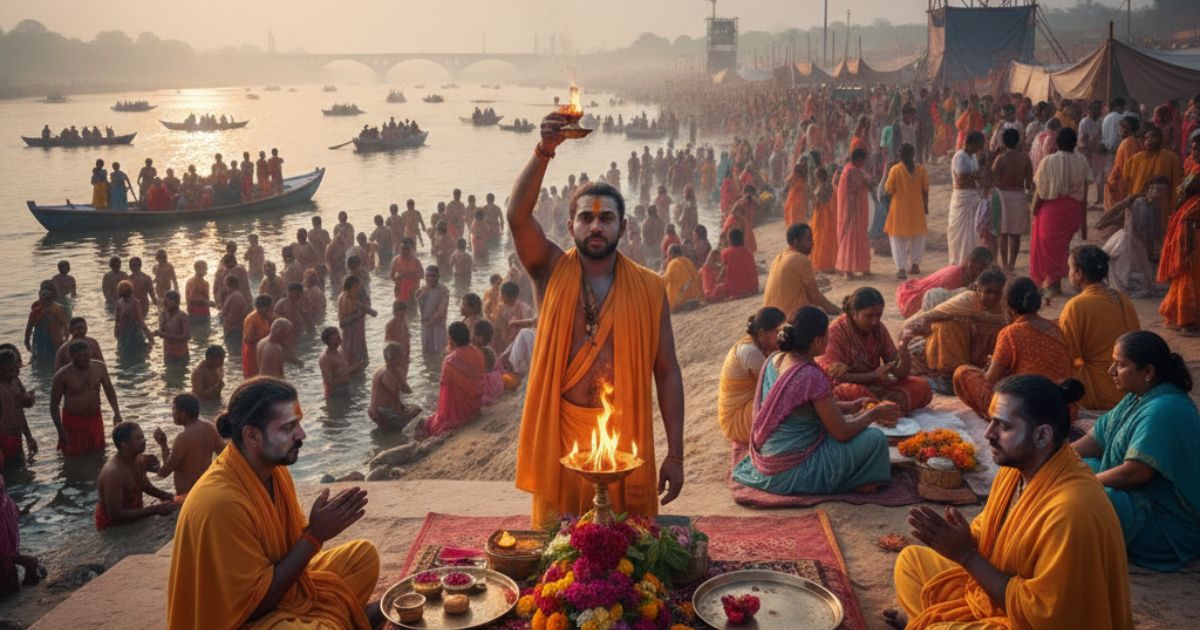
Ancient texts claim that even looking at the Sangam (darshan), touching its waters (sparshan), or drinking them (achamana) confers spiritual merit. But full immersion with proper mantras and rituals offers the ultimate benefit—freedom from compulsory rebirth.
Moksha Gateway
Prayagraj is classified as a “Moksha Tirtha”—one of seven locations in India where liberation is most accessible:
The seven Moksha Tirthas are:
- Ayodhya
- Mathura
- Haridwar
- Kashi (Varanasi)
- Kanchipuram
- Ujjain
- Dwarka
But even among these seven, Prayagraj holds special status because it’s where rivers (representing life’s flow) converge and lose their individual identities—a perfect metaphor for the soul merging with the divine.
The triveni sangam meaning extends to spiritual symbolism: just as three rivers become one, the individual soul (atman), material nature (prakriti), and supreme consciousness (brahman) unite here, facilitating the ultimate spiritual realization.
Scientific and Energetic Aspects of the Confluence
Geological Uniqueness
Modern science offers intriguing perspectives on the sacred rivers confluence:
Distinct Water Properties: Studies show that Ganga and Yamuna waters have different pH levels, mineral compositions, and microbial content. When they meet, a unique mixing zone is created where distinct properties interact.
Sediment Patterns: Geological surveys reveal fascinating sediment deposition patterns at the confluence, creating a unique topography unlike simple river junctions. The third component—possibly underground water streams—adds complexity.
Historical River Courses: Satellite imagery and archaeological evidence suggest multiple ancient river channels in the region, supporting the Saraswati narrative. Climate and tectonic changes over millennia altered river courses, but underground water channels may persist.
Energy Vortex Theory
Many spiritual traditions and modern energy workers describe the Sangam as a powerful energy vortex:
What is an Energy Vortex? Locations where earth’s electromagnetic field creates spiraling energy concentrations. These spots facilitate heightened spiritual experiences, healing, and consciousness expansion.
Sangam as Vortex: Practitioners report:
- Tingling sensations while bathing
- Spontaneous meditative states
- Emotional releases and healing
- Profound peace and clarity
- Synchronicities and spiritual experiences
Geomagnetic Factors: Some researchers theorize that the unique geology—water flow, mineral deposits, and underground formations—creates geomagnetic anomalies that affect human consciousness.
While mainstream science hasn’t validated these claims, the consistent reports across centuries suggest something beyond placebo effect operates here.
Astrological Importance
The prayagraj sangam significance multiplies during specific planetary configurations:
Kumbh Mela Astronomy: The Kumbh occurs when Jupiter (Guru) enters Aquarius (Kumbha) and the Sun enters Aries—a configuration that traditionally marks maximum spiritual benefit. The precise astronomical calculations determining Kumbh dates reflect ancient India’s sophisticated astronomical knowledge.
Magh Mela Timing: During Magh (January-February), the Sun transits through Capricorn while specific planetary alignments occur. These configurations are believed to:
- Open spiritual gateways
- Amplify ritual effectiveness
- Facilitate ancestral communication
- Enhance karmic cleansing
Personal Astrological Connections: Individual birth charts determine optimal timing for Sangam visits. Certain planetary periods (dashas) and transits make the pilgrimage more beneficial for specific people—another service AstroInsights.guru provides through personalized consultations.
Historical References: Prayagraj Through the Ages
Vedic Literature Mentions
The Rigveda, humanity’s oldest continuous religious text (circa 1500 BCE), references the sacred rivers confluence:
Hymns mention “Triveni” and “Prayag” as supremely holy. The Atharvaveda describes pilgrimage to river confluences as merit-generating acts. These ancient references establish that Prayagraj’s sanctity predates even recorded Indian history.
The Mahabharata extensively discusses Prayagraj in the Tirtha-yatra Parva (Pilgrimage section), describing it as the holiest of all tirthas where even devas (gods) come to bathe.
Buddhist and Jain Connections
Prayagraj’s significance transcends Hindu tradition:
Buddhist References: Buddha himself reportedly visited Prayag during his travels. Buddhist texts mention the confluence as a place of merit-making. Emperor Ashoka (3rd century BCE) built a pillar at the Sangam, recognizing its spiritual importance—this Ashoka Pillar still stands (though relocated) in Prayagraj Fort.
Jain Tradition: Jain texts also acknowledge the sacred rivers confluence as a tirtha. Several Jain tirthankaras are believed to have visited and blessed the location.
This inter-religious recognition suggests the Sangam’s spiritual potency is universally acknowledged, not limited to Hindu belief systems.
Medieval Accounts and Travelers’ Records
Historical travelers documented Prayagraj’s significance:
Hiuen Tsang (7th century CE): The Chinese Buddhist monk described Prayag as having numerous temples and bustling spiritual activity, with pilgrims from across India converging there.
Al-Biruni (11th century CE): The Persian scholar documented Hindu pilgrimage practices at Prayag, noting the confluence’s supreme importance in the Hindu hierarchy of sacred sites.
Akbar’s Recognition: The Mughal emperor Akbar built a fort at Prayag (1583 CE), recognizing its strategic and spiritual importance. He renamed it “Illahabas” (later anglicized to Allahabad), though it was officially renamed Prayagraj in 2018.
British Colonial Records: British administrators meticulously documented the Kumbh Mela gatherings, amazed by the millions who assembled—the world’s largest peaceful human gathering.
These diverse historical references across cultures and religions validate that something genuinely special exists at the sacred rivers confluence.
The Four Sacred Tirthas and Prayagraj’s Supreme Status
Hindu tradition recognizes four supreme pilgrimage sites where Kumbh Mela occurs:
- Prayagraj (Uttar Pradesh): Ganga-Yamuna-Saraswati confluence
- Haridwar (Uttarakhand): Where Ganga enters the plains
- Ujjain (Madhya Pradesh): On the Shipra River
- Nashik (Maharashtra): On the Godavari River
Among these four, ancient texts consistently rank Prayagraj as Tirtharaj—the emperor of pilgrimage sites. Why?
Multiple Confluence: Prayagraj is the only spot with three rivers (even if one is invisible/underground), making it geometrically and spiritually unique.
Vedic Authentication: The oldest scriptures give Prayagraj primacy, suggesting its recognition predates the other three sites.
Moksha Promise: While all four grant spiritual merit, Prayagraj specifically promises moksha—liberation itself—not just purification or blessings.
Creation Connection: The mythology connecting Prayagraj to Brahma’s first yajna and creation itself gives it foundational importance.
This supreme status explains why the Prayagraj Kumbh Mela attracts the largest crowds—up to 120 million visitors during the 2019 Ardh Kumbh.
Kumbh and Magh Mela: Amplifying the Sacred
The prayagraj sangam significance reaches its peak during two major festivals:
Kumbh Mela (Every 12 Years): Based on precise astronomical calculations, the Kumbh recreates the conditions of the mythological Samudra Manthan when amrita dropped at Prayagraj. The planetary alignments supposedly open maximum spiritual gateways, making this the most auspicious time for darshan and bathing.
Ardh Kumbh (Every 6 Years): A “half Kumbh” with significant but slightly lesser astronomical alignment.
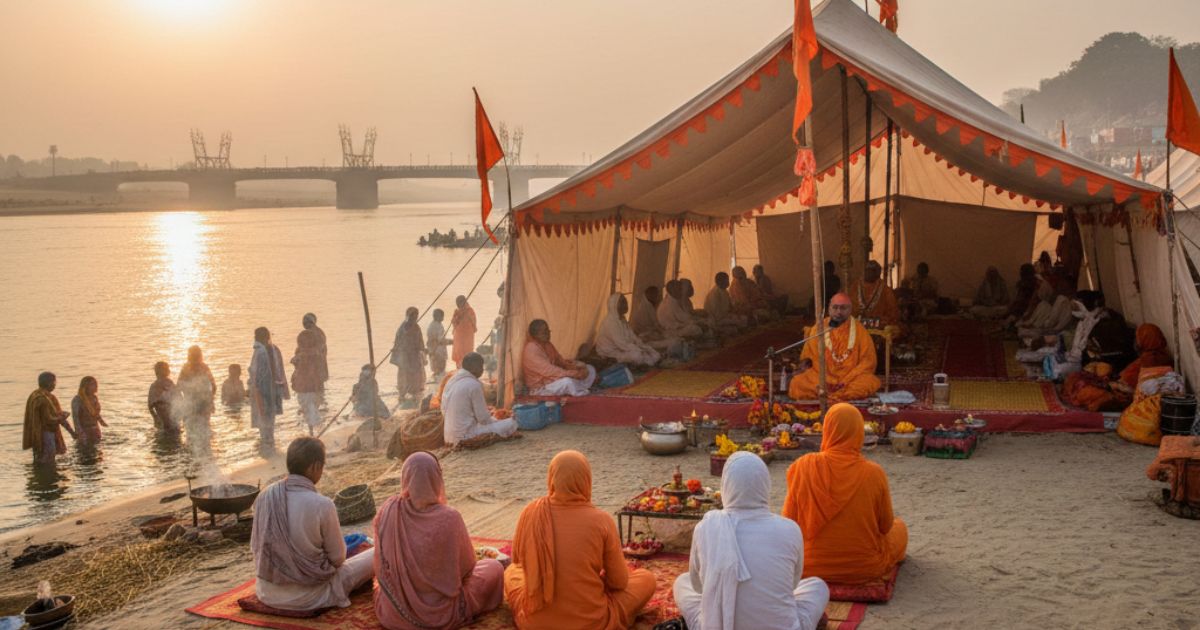
Magh Mela (Annual): During the Hindu month of Magh (January-February), a month-long gathering occurs where devotees observe Kalpvas—living on the banks following strict spiritual discipline.
Why Do These Events Amplify Sangam’s Power?
- Collective Consciousness: Millions of devotees praying simultaneously create enormous spiritual energy
- Planetary Alignment: Specific cosmic configurations enhance earth’s energy field
- Divine Presence: Tradition holds that devas descend to bathe during Kumbh
- Karmic Windows: These times offer accelerated karmic dissolution
- Community Support: Fellow seekers provide encouragement and shared devotion
Even skeptics acknowledge the palpable energy difference during these festivals—the atmosphere becomes electric with devotion.
Rituals That Gain Special Power at Sangam
Pitru Tarpan (Ancestor Rituals)
Perhaps no ritual benefits more from the sacred rivers confluence than Pitru Tarpan:
Why Sangam for Ancestor Rituals?
- The convergence point symbolizes the meeting of different dimensions—perfect for communicating with departed souls
- Saraswati’s invisible presence represents the subtle realm where ancestors reside
- Water is the medium connecting living and departed in Hindu philosophy
- The spiritual power concentrated here facilitates ancestral liberation
Many families travel to Prayagraj specifically to perform shraaddh (death anniversary rituals) and Pitru Tarpan, believing it grants peace to ancestors and removes Pitru Dosh (ancestral afflictions) from their horoscopes.
Asthi Visarjan (Ash Immersion)
Immersing cremation ashes at the Sangam is considered supremely beneficial:
Spiritual Rationale:
- The deceased soul receives blessings from all three rivers simultaneously
- The confluence’s moksha-granting power directly aids the departed soul
- It provides closure and peace to grieving family members
- It honors the deceased by offering them the highest spiritual benefit
Thousands annually bring ash urns to Prayagraj for this sacred act. The triveni sangam meaning includes this role as a bridge between life and death, physical and spiritual realms.
Sankalp and Vows
Taking spiritual vows (sankalpas) at the Sangam carries special weight:
Types of Sankalpas:
- Beginning a new spiritual practice
- Committing to life changes
- Seeking divine guidance for major decisions
- Dedicating oneself to a spiritual path
- Taking monk/renunciant vows
Why Sangam for Sankalpas? The location’s spiritual potency witnesses and empowers your vows. Making commitments in such a sacred space creates accountability and divine support for fulfilling them.
Many spiritual teachers conduct initiation ceremonies at the Sangam, recognizing that disciples initiated here receive special blessings.
Personal Experiences: Testimonies of Transformation
Beyond scripture and tradition, personal testimonies validate the prayagraj sangam significance:
Healing Stories: Countless reports exist of chronic illnesses improving or disappearing after Sangam bathing. While scientific verification is limited, the consistent patterns suggest something beyond coincidence.
Emotional Breakthroughs: Many describe profound emotional healing—releasing grief, finding forgiveness, overcoming depression—during or immediately after Sangam visits.
Spiritual Experiences: Common reports include:
- Visions of deities or divine light
- Spontaneous samadhi (meditative absorption) states
- Meeting spiritual teachers synchronistically
- Receiving answers to long-held spiritual questions
- Feeling tangible divine presence
Life Direction Clarity: Numerous pilgrims report that confusion about life direction, career, relationships, or spiritual path suddenly resolves during Sangam contemplation.
The Skeptic’s Experience: Even rationalists and skeptics often report unexpected experiences that challenge their worldview. The Sangam seems to touch even those who come without faith.
Comparing Prayagraj Sangam with Other Sacred Confluences
India has several river confluences (sangams), but none match Prayagraj’s status:
Devprayag (Uttarakhand): Where Bhagirathi and Alaknanda merge to form the Ganga. Highly sacred but involving two rivers, not three.
Vishnuprayag, Nandprayag, etc.: The Panch Prayag (five confluences) in the Himalayas are beautiful and spiritual but lack the mythological depth and moksha promise of Prayagraj.
Other Sangams: Various smaller sangams exist throughout India, each with local significance, but none carry scriptural authentication or historical importance comparable to the Triveni.
What Makes Prayagraj Unique?
- Three-river confluence (tri-sangam)
- Inclusion of invisible/sacred Saraswati
- Vedic textual authentication
- Moksha-granting status
- Historical continuity across millennia
- Universal religious recognition
- Astronomical significance (Kumbh calculations)
This combination of factors makes Prayagraj Sangam truly incomparable.
Modern Relevance: Why Millions Still Visit
In our materialistic, scientific age, why does the sacred rivers confluence still draw millions?
Spiritual Hunger: Modern life’s stress, meaninglessness, and disconnection create spiritual hunger that ancient sacred sites satisfy in ways temples and churches often don’t.
Ancestral Connection: In an age of broken families and lost traditions, performing ancestral rituals at Sangam reconnects people with lineage and heritage.
Alternative Healing: As faith in modern medicine wavers for chronic conditions, many seek spiritual healing at powerful locations like Sangam.
Bucket List Spirituality: Even non-religious Indians consider Sangam pilgrimage essential—a cultural experience validating Indian identity.
Global Hindu Diaspora: Non-resident Indians living abroad often plan Sangam visits during India trips, reconnecting with spiritual roots.
Scientific Curiosity: Researchers from multiple disciplines study the Kumbh Mela and Sangam, intrigued by its scale, organization, and reported phenomena.
Insta-Spirituality: Yes, social media plays a role—posting from Sangam during Kumbh has become a statement. But superficial motivation often transforms into genuine spiritual experience.
The prayagraj sangam significance endures because it addresses timeless human needs—meaning, purification, connection, and transcendence—that modernity hasn’t satisfied.
How to Experience the Sacred Energy of Sangam
Visiting Prayagraj Sangam is one thing; truly experiencing its sacred energy requires preparation:
Before Your Visit:
- Study and Understanding: Read about the triveni sangam meaning, mythology, and significance
- Intention Setting: Clarify why you’re going—healing? Ancestral rituals? Spiritual growth?
- Astrological Consultation: Determine optimal timing based on your horoscope
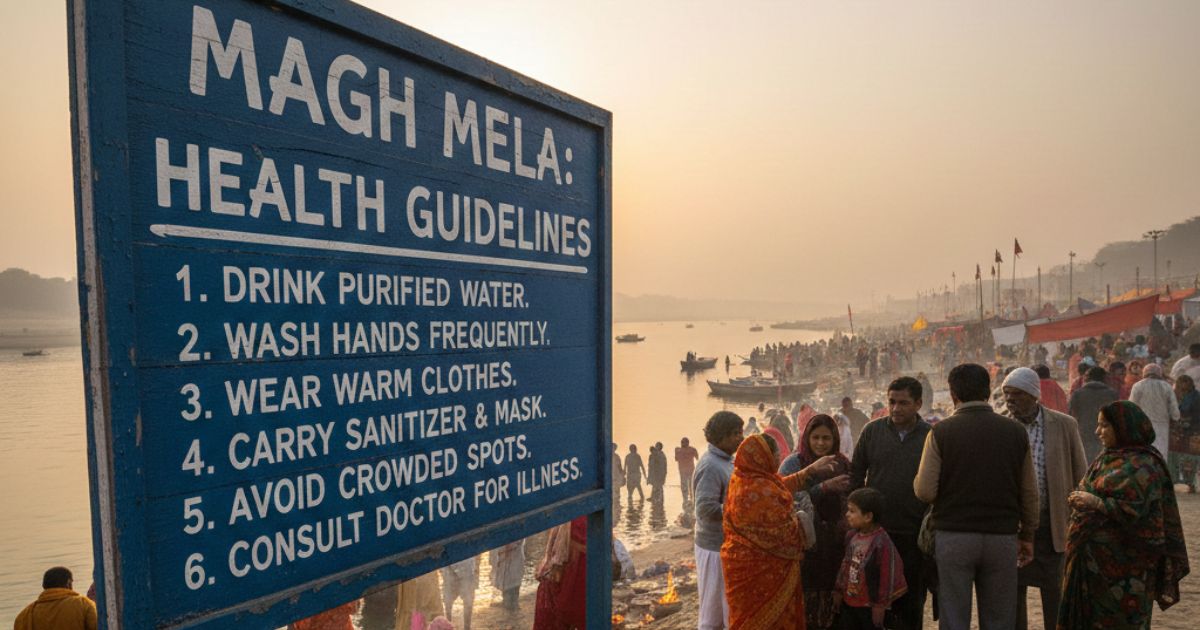
- Physical Preparation: The cold water and basic facilities require physical readiness
- Mental Preparation: Approach with reverence, not just tourist curiosity
During Your Visit:
- Sacred Bath: Immerse completely, chant mantras, invite purification consciously
- Meditation: Spend time in silent contemplation at the banks
- Ritual Participation: Engage in aarti, pujas, and ceremonies
- Seva (Service): Help fellow pilgrims, donate to genuine causes
- Mindfulness: Stay present, notice your internal experiences
- Documentation: Journal your thoughts and feelings
After Your Visit:
- Integration: Don’t immediately resume normal life; take transition days
- Continued Practice: Maintain spiritual practices inspired by the experience
- Sharing: Share insights with fellow seekers
- Gratitude: Regular thanks for the opportunity and experiences
- Follow-through: If you made sankalpas, honor them diligently
The sacred rivers confluence offers its blessings to all, but conscious engagement multiplies the benefits exponentially.
Conclusion
The prayagraj sangam significance transcends religious dogma or cultural tradition—it touches something fundamental in human consciousness. For over three millennia, this sacred rivers confluence has called to seekers, pilgrims, and saints. From Vedic rishis to medieval saints to modern spiritual seekers, all have found something at the Triveni that transformed them.
Is it the unique geology creating energetic phenomena? The power of collective faith generating morphic fields? The actual presence of divine grace at a location honored for so long? The accumulated prayers of billions over centuries creating a spiritual vortex? Perhaps all of these factors interweave, creating a space where the boundary between material and spiritual dissolves.
The triveni sangam meaning goes beyond three rivers meeting—it represents the convergence of heaven and earth, past and present, individual and universal, mortal and divine. At this singular point, the impossible becomes possible: karmic debts dissolve, ancestral curses lift, spiritual insights dawn, and the soul glimpses its own immortality.
Whether you understand it through mythology, science, philosophy, or direct experience, the Sangam remains what it has always been—a portal to transformation, a gateway to grace, a place where the finite touches the infinite.
In our fragmented, confused, often despairing modern world, sacred sites like Prayagraj Sangam remind us that the divine hasn’t abandoned humanity. Ancient wisdom still flows like the eternal rivers, available to all who approach with sincerity and reverence.
The sacred rivers confluence awaits—not just in Uttar Pradesh, but in the landscape of your own consciousness. The outer journey to Prayagraj mirrors an inner journey to your own Triveni, where body, mind, and spirit converge, where past, present, and future merge, where you discover that the sacred you sought externally has always resided within.
May your understanding of Prayagraj Sangam’s significance inspire your own sacred journey, wherever it may lead.
FAQs About Prayagraj Sangam Significance
1. Can the prayagraj sangam significance be experienced without Hindu belief, or is it exclusively for Hindus?
The sacred rivers confluence welcomes all sincere seekers regardless of religious affiliation. While Hindu tradition provides the primary interpretive framework, people from various faiths and even atheists report profound experiences at the Sangam. The site’s power operates beyond belief systems—many Buddhists, Jains, Sikhs, and even some Muslims and Christians visit with reverence. What matters is approaching with respect, openness, and genuine spiritual intent rather than casual tourism. The triveni sangam meaning transcends sectarian boundaries, addressing universal human longings for purification, peace, and transcendence. That said, participating in specific Hindu rituals (like Pitru Tarpan) obviously requires engagement with Hindu spiritual framework. AstroInsights.guru can guide seekers from any background in accessing the Sangam’s benefits appropriately.
2. What is the best time to visit Prayagraj Sangam for maximum spiritual benefit?
The answer depends on your personal astrological chart and spiritual goals. Universal Peak Times: Magh Mela (January-February annual), Kumbh Mela (12-year cycle), and especially Mauni Amavasya (new moon during Magh) offer maximum collective energy and spiritual potency. Personal Optimal Times: Your individual birth chart determines when Sangam visit benefits you most—certain dashas, transits, and planetary periods make pilgrimage exponentially more effective. Practical Considerations:Non-festival times offer quieter, more contemplative experiences without crowds, though with less collective energy. Astrological Guidance: AstroInsights.guru’s astrologers calculate your personalized muhurat (auspicious timing) based on: your natal chart, current planetary transits, specific intentions (healing vs. ancestor rituals vs. general purification), and practical constraints. Generally, Thursdays (Jupiter’s day) and Mondays (Moon’s day) at the Sangam are considered highly favorable, especially during morning hours (Brahma Muhurta).
3. How does the sacred rivers confluence physically look—can you actually see three different rivers merging?
Visually, you can clearly distinguish two rivers at the Sangam: the Ganga flowing from the north with greyish-white, lighter-colored water, and the Yamuna coming from the west with darker, blue-green water. The convergence creates a stunning visual effect—a distinct line where the two colored waters meet before gradually mixing. Photographers love capturing this phenomenon. The third river, Saraswati, remains invisible to physical eyes, though some spiritually sensitive individuals claim to perceive subtle energy or even visual shimmer in the area where she’s believed to flow underground. The viewing experience depends on season and water levels—monsoon creates more dramatic visual contrast, while summer shows clearer color distinction. The best viewing points are from boats on the river or from the fort ramparts. The triveni sangam meaning includes this visible-invisible dynamic, reminding seekers that reality contains both manifest and unmanifest dimensions.
4. Are there any scientific studies validating the spiritual or healing properties attributed to the prayagraj sangam significance?
Scientific validation remains limited and controversial. Existing Research: Water quality studies show Ganga water contains unique bacteriophages and maintains purity longer than ordinary water—properties recognized even by British colonial authorities. Geological surveys confirm unusual underground water channels and ancient river systems in the region, supporting Saraswati’s historical existence. Some researchers have documented electromagnetic anomalies at the confluence, though peer-reviewed publications are scarce. Challenges to Scientific Study: Spiritual experiences are inherently subjective and difficult to measure scientifically. Placebo effect, confirmation bias, and cultural conditioning complicate research. The massive Kumbh gatherings present logistical challenges for controlled studies. Anecdotal Evidence: Thousands of documented testimonies describe healing, transformative experiences, and life changes following Sangam visits. While not scientific proof, the consistency and cross-cultural nature of reports suggest phenomena worth investigating. Modern Perspective: Perhaps the question itself is flawed—demanding scientific validation for spiritual phenomena is like demanding spiritual validation for scientific facts. Different domains of human experience require appropriate epistemologies. The sacred rivers confluence operates in the spiritual domain, where direct experience trumps external validation.
5. If I cannot physically visit Prayagraj Sangam, can I still receive its spiritual benefits?
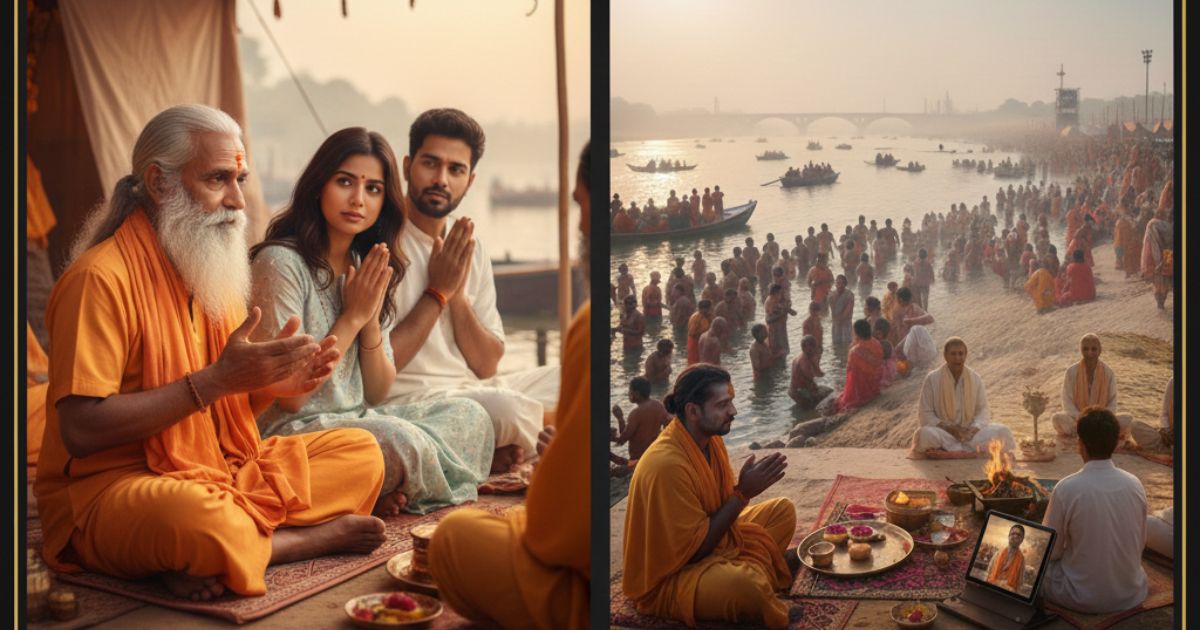
Yes, though the experience differs from physical presence. Traditional Solutions: Ancient texts describe “manasa snana” (mental bathing)—visualizing yourself bathing at the Sangam with full devotion. This practice acknowledges that spiritual reality operates beyond physical limitation. Keeping Ganga water from the Sangam at home and adding drops to your daily bath while chanting appropriate mantras brings the Sangam’s blessings to you. Proxy Rituals: AstroInsights.guru and similar services arrange pandits to perform rituals on your behalf at the actual Sangam. You provide sankalp (intention), birth details, and offerings; experienced pandits conduct the complete ceremony with video documentation. This is spiritually valid—your sincere intention matters more than physical presence. Virtual Participation: Live-streaming of Magh Mela and Kumbh events allows global participation. While watching, you can synchronize your meditation and prayers with the actual ceremonies. Spiritual Principle: The prayagraj sangam significance ultimately points to an inner reality. The outer Sangam represents the inner convergence of different aspects of your being. Through meditation, you can access this inner Triveni anywhere. AstroInsights.guru’s Remote Services: We specialize in helping those unable to physically visit still receive Sangam’s blessings through: proxy puja arrangements, personalized mantra practices, astrological remedies, online ceremonies, and spiritual guidance that brings the Sangam’s essence to your location.
AstroInsight.guru’s Guidance Why Prayagraj Sangam is Considered
Maximizing your Prayagraj Sangam experience benefits from expert astrological and spiritual guidance:
Our Comprehensive Sangam Services:
Pre-Pilgrimage Consultation:
- Horoscope analysis to determine optimal visit timing
- Identifying specific rituals most beneficial for your chart
- Understanding which planetary doshas can be remedied at Sangam
- Personalized mantra recommendations for maximum benefit
Ritual Planning:
- Customized puja package suggestions based on your needs
- Pandit booking for authentic ritual performance
- Coordination of Pitru Tarpan and ancestor ceremonies
- Special ritual arrangements during Magh Mela or Kumbh
During Your Visit:
- Live chat support for any questions or challenges
- Emergency pandit availability
- Guidance on navigating the Mela grounds
- Real-time astrological muhurat calculations
Post-Visit Integration:
- Follow-up consultations to integrate experiences
- Ongoing spiritual practice recommendations
- Addressing any post-visit challenges
- Planning future spiritual journeys
Special Services:
- Proxy Puja: If you cannot physically visit, we arrange pandits to perform rituals on your behalf with video documentation
- Group Pilgrimage Coordination: Organizing complete pilgrimage packages for families or groups
- Online Puja Services: Participate in Sangam rituals virtually from anywhere in the world
Our holistic approach combines:
- Deep astrological expertise
- Traditional spiritual knowledge
- Modern logistical support
- Genuine care for your spiritual journey
Don’t navigate the profound opportunity of Prayagraj Sangam without expert guidance. Let AstroInsights.guru ensure your pilgrimage is spiritually optimal and practically smooth.
Connect with AstroInsight.guru:
- 🌐 Website: astroinsights.guru
- 📞 Phone: +916306407641
- 📧 Email: astroinsights.guru@gmail.com
- 🤖 AstroInsights AI: https://bit.ly/astroguru_ai